A pellet boiler is a heating appliance that uses wood pellets as fuel, designed for automated operation throughout the entire heating season. Over the last decade, it has become one of the most frequently chosen heating technologies for buildings requiring high thermal output, and at the same time the most strictly regulated category of solid-fuel boilers in the European Union. This guide systematises the knowledge needed to select, evaluate and operate a pellet boiler — from design fundamentals, through emission classes, to typical applications by output range.
How a pellet boiler works
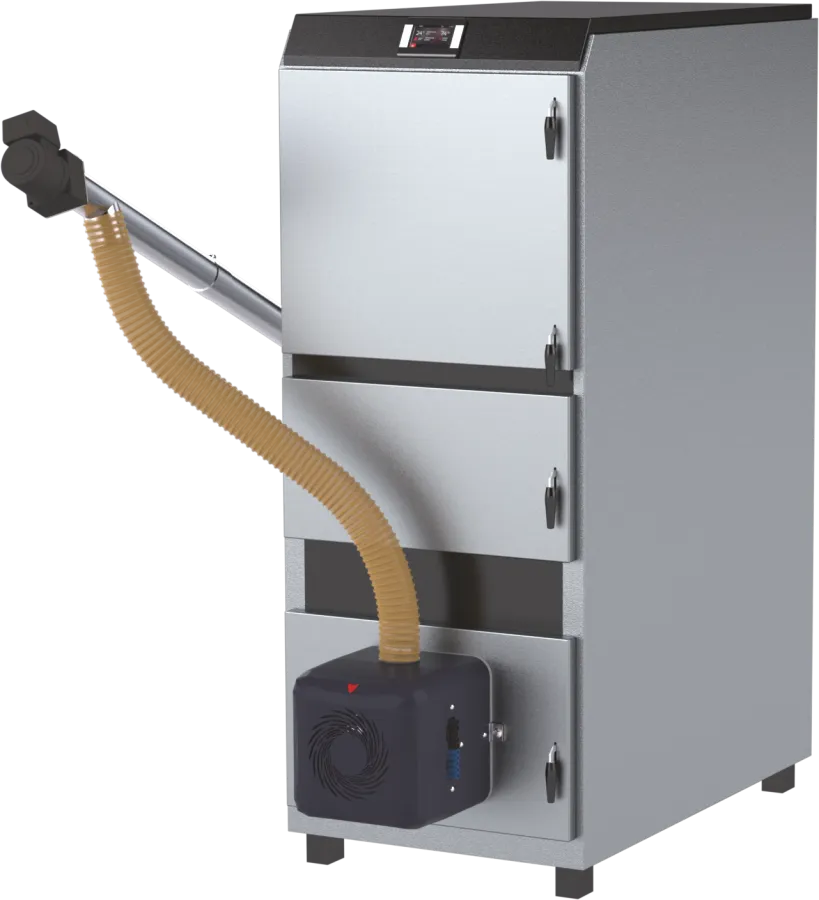
A pellet boiler is a system consisting of several cooperating subassemblies. The operating process can be described in five steps:
Fuel storage — wood pellets are stored in a hopper (in small boilers, 100–500 kg) or a silo (in commercial and industrial installations, from a few tonnes up to several dozen tonnes)
Fuel feeding — a mechanical feeder (typically a screw feeder, 60–90 mm in diameter) transports pellets from the hopper to the burner. The feeder length depends on the boiler-room configuration and ranges from 0.5 to 5 metres
Combustion — the pellet burner precisely doses fuel and air into the combustion chamber. Combustion temperature depends on burner technology, chamber material and pellet quality
Heat exchange — thermal energy from the flame and hot flue gases is transferred through the heat exchanger to the water in the boiler jacket, and then to the heating system
Flue gas discharge — flue gases are directed to the chimney, and ash is removed from the chamber (in modern designs largely automatically)
Each of these stages is controlled by the boiler controller — in modern systems together with flue gas temperature sensors, a lambda probe and weather compensation. Together, this forms a fully automatic heating system requiring user intervention mainly for fuel refilling and periodic maintenance.
Types of pellet boilers
Various pellet boiler designs are available on the market, which can be classified according to several criteria:
By fuel feeding method
Automatic — pellets are fed mechanically by a screw, the controller regulates dosing in real time. The dominant design for modern installations
Semi-automatic — the user refills pellets in a smaller hopper near the burner, feeding into the combustion chamber is automatic. Less common
By burner design type
The pellet industry distinguishes six burner design types. Each differs in the way fuel is delivered to the combustion chamber and in the mechanics of the combustion chamber.
Drop-feed — fuel falls by gravity into the combustion chamber (without an internal screw). An older technology, currently being phased out
Trough — fuel is fed by a horizontal screw into a trough chamber. Universal output range (5–500 kW), handles various fuels
Rotary — horizontal screw + combustion chamber rotating around its own axis. Self-cleaning chamber. Dominant in the residential segment
Step grate — a stair-shaped grate, moves horizontally every other row. Commercial segment (50–250 kW)
Industrial boilers (250–500 kW) — for large facilities, local heating plants, industrial sites
By accepted fuel
Wood pellets A1 only — the highest pellet quality (standard EN ISO 17225-2), ≤ 0.7% ash, low emissions. Typical for modern residential boilers
A1 pellets + lower classes (A2, B) — accept pellets with higher ash content. Industrial boilers with moving grates (e.g. Walking Grate)
Wood pellets + agropellets — boilers with moving grates in the commercial and industrial segments (step grate, Walking Grate) accept agropellets in addition to wood pellets
By integration with a wood gasification boiler
Dedicated pellet boiler — designed from the ground up for pellets
Wood gasification boiler + pellet burner (HG) — a single boiler handles two fuels: log wood (main operation) and pellets (backup/automatic). Requires a special burner with a Fan Flap hermetically cutting off the air supply during gasification operation
Manual-feed boiler with retrofit burner — a retrofit solution, described in detail in a separate guide
Key parameters for selecting a pellet boiler
When choosing a specific boiler model, several groups of parameters should be evaluated. Each of them may be decisive for a given installation:
Parameter
Meaning
Typical values
Rated output
Maximum thermal output under nominal conditions
4–500 kW
Modulation range
Operating range in which the boiler maintains declared efficiency
30–100% of rated output
Seasonal efficiency (ηs)
Ecodesign parameter
≥ 75% (≤ 20 kW), ≥ 77% (above)
Emission class
Compliance with EN 303-5:2021
Class 5 (requirement in Poland)
Accepted fuel
Pellet type approved by the manufacturer
A1 pellets (standard), A2/B (industry)
Hopper capacity
Pellet mass in a standard hopper
100–500 kg (small), 1–30 t (silo)
Type of controls
Controller + extensions
Modulation + lambda probe + remote control
ErP energy class
EU label for boilers ≤ 70 kW
A+, A++
Output sizing itself requires taking several factors into account — building floor area, insulation condition, climate zone, additional DHW load. Practical rule: the boiler output should cover the calculated heat demand at -20°C with a safety margin, but should not be oversized by more than 10–15% (oversizing reduces seasonal efficiency).
Emission classes and certifications — a brief overview
A pellet boiler legally placed on the EU market must meet the requirements of Ecodesign (Regulation 2015/1189) and — in Poland — emission class 5 according to PN-EN 303-5:2021. Key limits:
In a typical single-family home with a floor area of 100–300 m² and standard insulation, boilers with an output of 10–26 kW are used. For energy-efficient buildings (new homes, 20+ cm insulation), a 10–16 kW boiler is often sufficient. For older, uninsulated homes — 20–30 kW.
The most commonly chosen solutions are pellet boilers with a rotary burner (self-cleaning, low service costs) or a trough burner (wide fuel range, proven design). Wood gasification boilers with backup pellet operation use HG rotary burners with a Fan Flap.
For multi-family buildings, small hotels, offices, schools and production plants, boilers with outputs of 50–250 kW are used. Key in this segment are:
Reliable continuous operation throughout the entire heating season
Automatic grate cleaning (Easy Clean-Out system, step grate with heat-resistant cast iron plates)
Independent control of primary and secondary air (two EC fans)
Ability to work with a buffer tank (variable load)
Integration with BMS (Building Management System)
Industrial facilities and heating plants (250–500 kW)
For local heating plants, production halls, public utility buildings and large agricultural facilities, industrial boilers of 350–500 kW are used. Specific requirements:
Continuous operation for thousands of hours per year
Ability to burn lower-quality pellets (A2, B) — reduces operating costs
Moving grate of the Walking Grate type (segmented trough grate with independent section movement)
Automated removal of ash and slag
Fire Barrier system — hermetic separation of the combustion chamber from the feeder
Large hoppers/silos — 10+ tonnes of pellets, automatic loading
Critical components of a pellet boiler
The performance and durability of the boiler depend on the quality of several key components. Each of them can be a decisive factor differentiating the solutions available on the market:
Combustion chamber / heat exchanger — material (boiler steel, heat-resistant cast steel), design (single/multi-pass flue gas flow), wall thickness. A multi-pass heat exchanger increases the heat exchange surface and raises efficiency
Burner — the heart of the boiler. Responsible for combustion quality, emissions and reliability. The choice of burner type (trough / rotary / step grate / Walking Grate) depends on output, fuel and installation requirements.
Control system — boiler controller with temperature sensors, lambda probe (optional), weather compensation, smart home integration. Advanced systems handle multiple heating circuits, DHW and a buffer
Fuel feeder — flexible or rigid screw, with a diameter adapted to the output and transport length
Hopper / silo — affects operating autonomy without refilling. For residential boilers typically 200–500 kg (a few days of operation), for commercial ones — 1–5 tonnes
Ash removal system — ash pan (small boiler) or automated ash transport system (large boiler)
Chimney — boiler-chimney cooperation requires adequate chimney draft (independent of wind), liner material resistant to acidic condensate and appropriate dimensions
Pellet boiler vs other heating systems
When deciding on a pellet boiler, the investor usually compares it with several alternatives:
Heat pump — in new, energy-efficient buildings often integrated with photovoltaics. In older buildings with high supply temperatures, a pellet boiler may be more advantageous.
Condensing gas boiler — unbeatable where natural gas is available. The pellet boiler gains an advantage in facilities without a gas grid or with a variable energy cost structure
Wood gasification boiler — pellets are more convenient to operate (automation), log wood is often cheaper. The combination of a wood gasification boiler + pellet burner (HG) combines both worlds
Oil boiler — being phased out due to fuel costs and regulatory restrictions. Retrofitting an oil boiler with a pellet burner is one of the typical scenarios
Retrofitting an existing boiler vs buying a new one
When the existing installation is based on an older boiler (manual-feed coal, wood or oil), instead of replacing the entire unit, retrofit by installing a pellet burner is often considered. This is possible if:
The combustion chamber of the existing boiler has suitable dimensions and is in good technical condition
It is possible to create a mounting opening for the burner
There is space in the boiler room for the pellet hopper and the feeder tube
The chimney meets the requirements for operation with a pellet boiler
Detailed In cases where retrofitting is not technically or economically justified, a new boiler designed from the ground up for pellets is the better choice.
Operating a pellet boiler
A modern pellet boiler is designed for minimal user intervention. Typical operating tasks:
Refilling the pellet hopper — every 3–7 days for a residential boiler, daily for large commercial hoppers
Emptying the ash pan — every 1–2 weeks (residential boiler) or every few days (commercial boiler)
Visual inspection of the combustion chamber — once a month
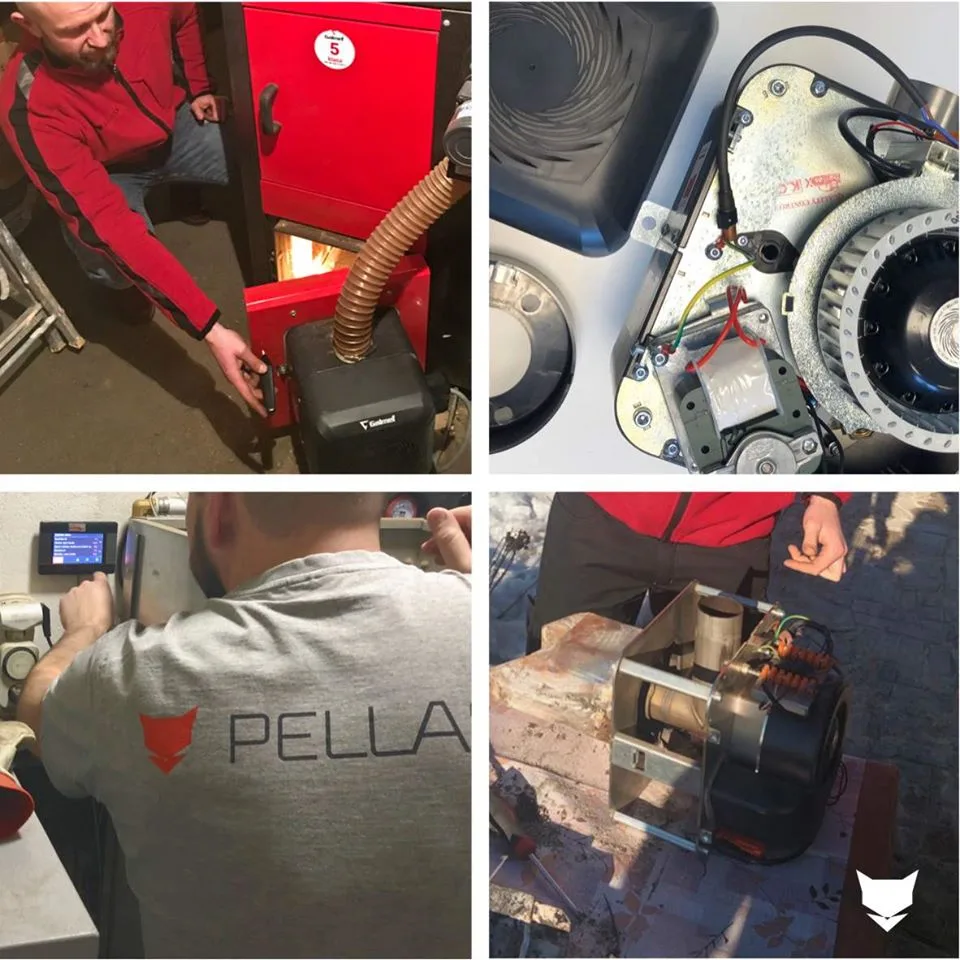
Seasonal inspection by an authorised service — once a year, outside the heating season
You can find service recommendations on the PellasX Service page. Pellet quality is critical for component longevity — using class A1 pellets (ENplus A1 certificate) extends the service interval and reduces combustion chamber wear.
Where to buy a pellet boiler — the distribution network
The pellet boiler market in Poland and the EU is based on a multi-tier distribution network:
Boiler manufacturers — companies producing complete boilers with their own burners or burners supplied by OEM partners
Distributors — regional distributors serving installers and specialist shops
Authorised installers — installation companies trained by the manufacturer, authorised to perform warranty service
Specialist shops — industry sales points with technical knowledge and advisory services
PellasX, as a pellet burner manufacturer, operates exclusively in a B2B model — burners are supplied to boiler manufacturers (OEM), distributors and authorised installers. For the end investor, the point of contact is the boiler manufacturer or authorised installer. If you are planning to purchase a pellet boiler with a PellasX burner, contact the boiler manufacturer, distributor or installer in your region — on request, we will refer you to a partner.
Summary — key decisions when choosing a pellet boiler
Define the heat demand — design calculations for the building (at least in accordance with PN-EN 12831-1) or an expert assessment by the installer
Choose the emission class and efficiency — a class 5 boiler with Ecodesign A+ or A++ is the standard for new installations
We have once again been named a laureate of the 7th edition of the programme organised by the Ministry of the Environment — GreenEvo – Green Technology Accelerator.
We use cookies on this site with your consent (expressed by using the site without changing your browser settings) for correct site functionality and analytics. Details, including information about mechanisms for choosing or accepting cookies and their removal, can be found in our privacy policy.