

Service technician tips
Service technician tips
Not sure if your installation is working correctly? Check out the most common tips from our factory service technicians.
On forums, Facebook groups, etc., we see more and more questions like: “look at the boiler’s operation chart, tell me if it’s okay?”.
The first thing that comes to a service technician’s mind: “sorry, not enough data”.
To determine whether the boiler (or rather the entire installation) is operating correctly, we need to know what we are heating and what boiler output we are dealing with. A boiler sized tightly to the building (maximum boiler output matched to the building’s maximum demand) should operate differently than an oversized boiler (maximum boiler output much higher than the building’s maximum demand). Reality shows that both installers and investors are afraid of tightly sized boilers, and the majority of boiler rooms that service technicians deal with are boiler rooms with “slightly” oversized boilers. Is this a big problem? Absolutely not!
We just can’t forget about appropriate control, which will “tame the beast so it doesn’t consume so much”. We are talking about a room thermostat (controller). A thermostat plus a bit of knowledge from the installer or service technician and we can have everything under control — the boiler will operate when needed, and its seemingly excessive output will be an advantage thanks to which, after a longer shutdown, the boiler will be able to reach temperature quickly.
Here’s an example: a 130 m² house, well insulated, built to new standards, with underfloor heating. A 16kW boiler installed. It is plainly visible that the boiler’s nominal output is too high — even assuming standards for an uninsulated building (100W/m²), it’s too much, and we are dealing with a building whose maximum demand according to regulations should be 40W/m². Unfortunately, the installer did not propose any control to the customer beyond temperature regulation on the heating circuit (thermostatic mixing valves).
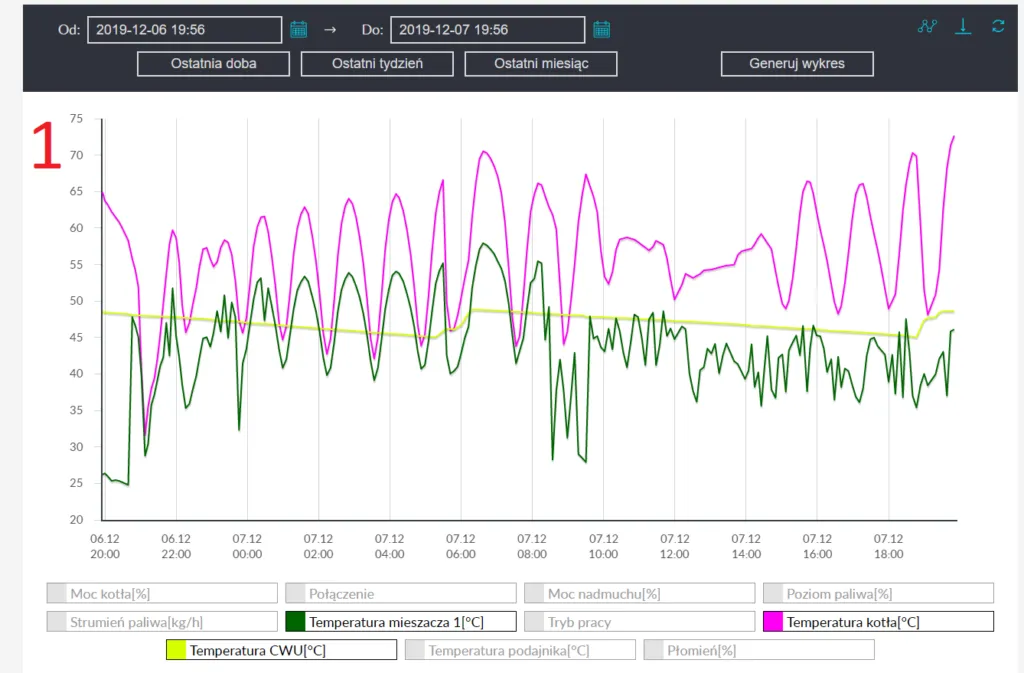
In the image marked number 1 we can see an example chart of the boiler’s operation over one day. To say it wasn’t good would be an understatement. The boiler ignited multiple times during the day — it would quickly overheat, shut down, then the boiler temperature would drop again and the boiler would repeat this cycle a dozen or even more than twenty times a day. The consequence was high fuel consumption and faster wear of the igniter — and it was precisely due to igniter failures that our service team came to the customer. Over 6,000 ignitions in a year and a half. The customer was aware that things were not good, and there was no need to present too many arguments to convince him to purchase and install a thermostat.
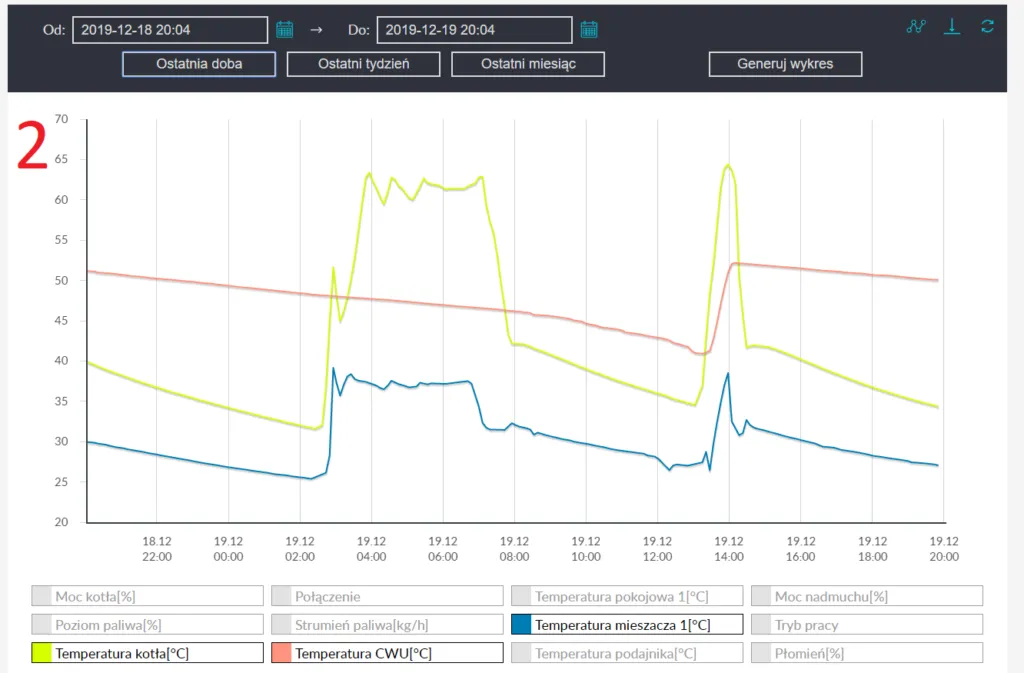
In image number 2 the effect is visible: two ignitions per day, smooth and calm operation, shutdown, standstill. This is how a boiler with a thermostat operates with underfloor heating. In the case of radiators — there would probably be a few more ignitions, but it would still be better — the temperature in the house under control, lower fuel consumption, fewer ignitions.
PellasX service team recommends!
Link to PellasX thermostats: https://pellasx.com/products/room-control/
